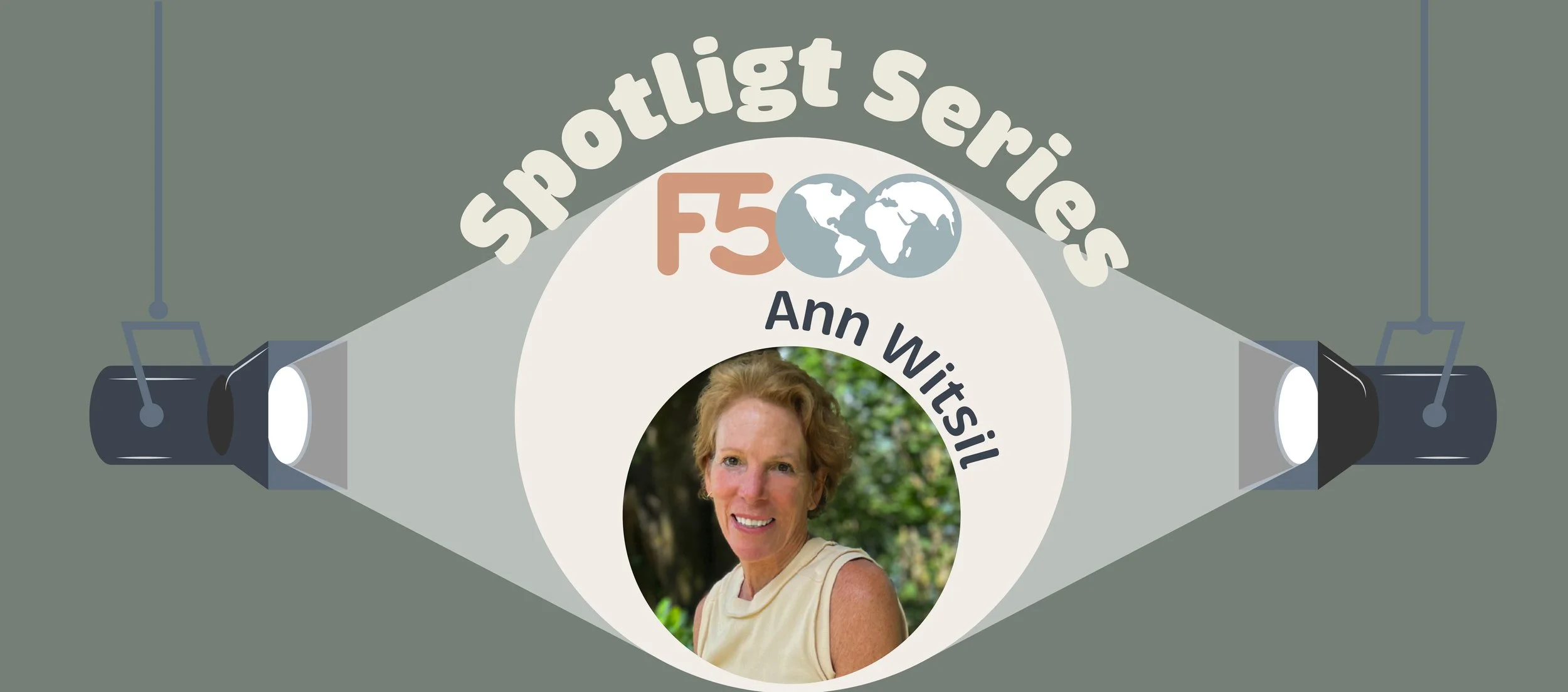
Meet Ann Witsil: Creating “Safe Zones” Where Opposites Actually Work Together
“There’s no single right answer—but if we listen to understand, we might find a way forward.”
That belief sits at the center of Ann’s work: bringing together people who don’t agree, and helping them move forward anyway.
Finding the Path to This Work
Ann started in banking, leading a market research team through a period of rapid growth and change. Over time, something became clear: organizations can buy, sell, merge, and expand, but none of it works if people are not aligned. “If the teams didn’t understand the vision, there was no reason to play.”
That realization shifted her focus from numbers to human dynamics so she could understand how people build trust, how they collaborate, and how shared vision actually forms. As a strategic facilitator, her work has centered on helping organizations find a pathway forward together. Especially across environmental and social justice issues.
Why Future 500
Future 500 felt like a natural fit: “The mission aligns completely with my own. Finding common ground between seemingly disparate parties.” Ann is drawn both by the chance to contribute and by what she continues to learn from the people around them.
Perspectives on the Field
Lately, Ann has been paying close attention to how organizations are responding to shifting political and regulatory pressure. Some are holding steady, others are quietly adjusting their strategies or messaging, and some are taking a more cautious, less visible approach, assuming the moment may pass. “It’s interesting to see which organizations are adjusting their strategies and marketing positions and which are taking a more obfuscated path, acknowledging that this too shall pass.”
Building Trust Across Differences
Ann describes the work in surprisingly simple terms: it starts with getting people in the same room and creating the conditions for honest conversation. “That is the path to understanding and finding a way forward, better together.”
But she’s quick to point out that the conversation itself is only the beginning. Even when people find alignment in the room, it doesn’t always last. Once they return to their organizations, old habits tend to resurface.“When time lapses and folks return to their organizational environment, it’s too easy to slip back into corporate speak.”
For Ann, that’s where the real work is. Trust isn’t built in a single moment. It requires staying in relationship, continuing the dialogue, and resisting the pull back into default positions. “If these seemingly opposing entities are spending time and money fighting each other, why not drop the pretenses and figure out a way forward together?”
She often turns to a natural analogy to explain what that kind of space can look like. In coral reefs, there are “safe zones” where predators and prey temporarily suspend their roles. Fish that would normally compete or hunt instead come together to be cleaned and healed, lowering their defenses just long enough to recover. It’s a reminder that even in the most unlikely environments, space can be created for trust to take hold, if only for a moment.
Perspectives That Challenge the Field
Ann pushes back on the idea that there’s a single “right” answer. In her experience, there usually isn’t.
Instead, she focuses on how people show up to the conversation. The difference, she says, often comes down to a shift in language and mindset. It starts with simple phrases that open rather than close:
“I don’t know.”
“Help me to understand.”
“That’s interesting; tell me more.”
“Are you willing to work with me to figure out a way?”
Just as important is what gets left unsaid. The default responses that shut conversations down:
“Let me tell you how we’re going to do this.”
“We just don’t have the time or budget to do something different.”
“I don’t think I can sell this to the leadership team.”
For Ann, this is where real progress begins. Not with certainty, but with curiosity. Not with complexity, but with simplicity. “Less is more,” she says. “Think first, talk later. Start with one-on-one conversations before going social.”
Looking Ahead
Looking forward, Ann hopes Future 500 becomes globally recognized as a trusted force that brings stakeholders together to address critical environmental and social challenges and a place where honest dialogue leads to real progress.
A Personal Note
Earlier in their career, Ann believed change happened at the global level. Over time, that perspective shifted. “Change often starts locally, where people know each other and are accountable to seeing things through.”
That shift has been shaped, in part, by time spent in nature.“I am always humbled by nature’s wisdom and power. The balance, the interdependence, the cycles.”
It’s a reminder that progress isn’t something you force. It’s something you build, through connection, patience, and a willingness to listen.